
ECOTONES
In August we spent two weeks at Knockvologan for the research and development phase of our project ‘ecotones’. ‘Ecotones’ are spaces in which different ecosystems cross over, or gradually merge into each other. These crossover spaces are often richer in biodiversity than the ecosystems on either side, due to the unique conditions present here. As well as being rich in biodiversity, ecotones represent liminal spaces that are so rich in songs, myth, and customs within the Gaelic tradition. Our music was inspired by both the ecology of these spaces and the myths that arose from them.
Knockvologan provided us with perfect space to explore the ecotones project. Not only are the studios in very close proximity to the ecotone of land and sea, the studio also represents an ecotone between farmed land and wild land. We felt very lucky to have the eyes and ears of Miek and Rutger to guide us, calling our attention to the remarkable geology and ecology at both the macro and micro level! Once tuned into the landscape, we felt the ideas and melodies flowing.
On the west coast, the landscape was once enchanted with stories that connected people to nature. As we delved into these stories during our residency, we began to understand how myths functioned in this connective role. Sometimes these myths provided explanations for things in nature. For example, myths of barnacle geese being born out of barnacles provided explanation of why a migratory bird suddenly appeared in Spring; the myth of the Cailleach (giantess of Erraid) forgetting to put a lid on a well explained the formation of loch awe. Sometimes the myths might have acted as warnings e.g. an outcrop being called the Cailleach’s point to warn boatmen of the risks of a choppy sea when sailing around there.
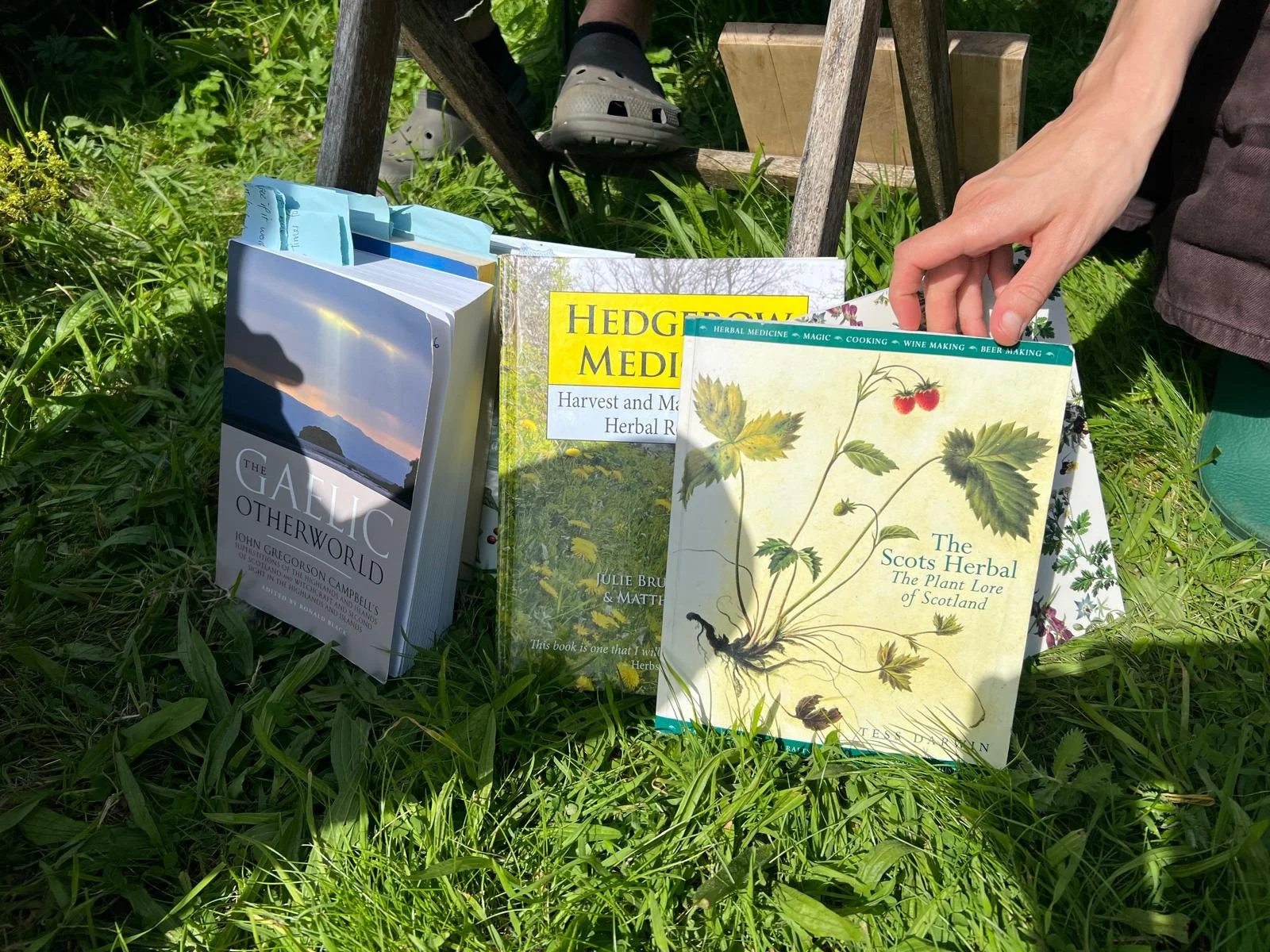
Many of these stories have since been forgotten, and many of the stories that can be found in records are fragments that are often difficult to make sense of without an understanding of the local context. This context might be an understanding of the local landscape where the story arose, or it might be an understanding of the local Gaelic customs that would have once existed in the area a story was told. As well as this the gaelic words and phrases do not always translate simply into English. To help us fill in some of these crucial links we worked with a local Gaelic speaker, Alasdair Whyte, who is a Gaelic tradition bearer from Mull and spends much of his time researching songs, stories and Gaelic place names from the area. His wisdom was invaluable to understanding the stories which we came across in our research.
One day during our stay at Knockvologan we had an important dinner discussion with Miek and Rutger. We discussed our idea for the music to take us on a musical journey from sea to land, inspired by the myths and ecotones along the way (e.g. the intertidal zone, the machair, the saltmarsh to name a few). As we move inland from the sea, we plot an imaginary line. Miek and Rutger talk about how lines are rarely straight in nature. It’s a liberating idea. Just as the coastline weaves in and out, our project can also weave in and out between myths, customs and ecotones. Rutger encourages us to see where our research takes us, and then plot the line to fit our material, rather than plotting a line which we have to shoehorn our research into.
During our discussions, we also talked about what it meant to be modern folk artists. How can we keep the tradition fresh without feeling like our artform is retelling history that is no longer relevant. Storytellers would have at one time weaved their stories to fit their audience and surroundings. It was only when the stories became written down that they became more fixed. During our residency we realised we didn't need to see these resources so much as fixed historical artifacts but dreams that could be respun with music in a way that felt relevant and fresh for us. Again this was liberating for our creative process.
At the end of our two weeks we did a work in progress sharing inviting local friends and artists to give their feedback on our work. Before the show we were nervous at the prospect of sharing fresh ideas that didn't feel ready to perform. However in the end it was great to invite the audience in on the creative process and we could tell they were really engaged in this role of cocreation. It felt particularly special to share stories and music that might connect people to the local rocks, islands, plants and animals that they knew so well.
In the middle of a climate crisis, we are often expected to care about protecting nature, but in this world many people go about their lives in total disconnect from the natural world around them. The first step has to be connecting people to the natural world,so that they want to protect it. During our time at Knockvologan we began to question what the role of myth could be here. Can these old stories still act as a connective tissue between humans and nature? How can our music be used to bring these stories alive in today’s world?
We left Knockvologan with our hearts full; with the feeling like our project mattered and has the potential to connect people to the landscapes around them. Our ideas had grown in confidence, and we felt like we could delve into the project with more of our own creative freedom. We felt grateful to the land and sea around us, to the Gaelic stories and customs that have been passed down, and to the community on the Ross of Mull that was so open in welcoming us and hearing our ideas!